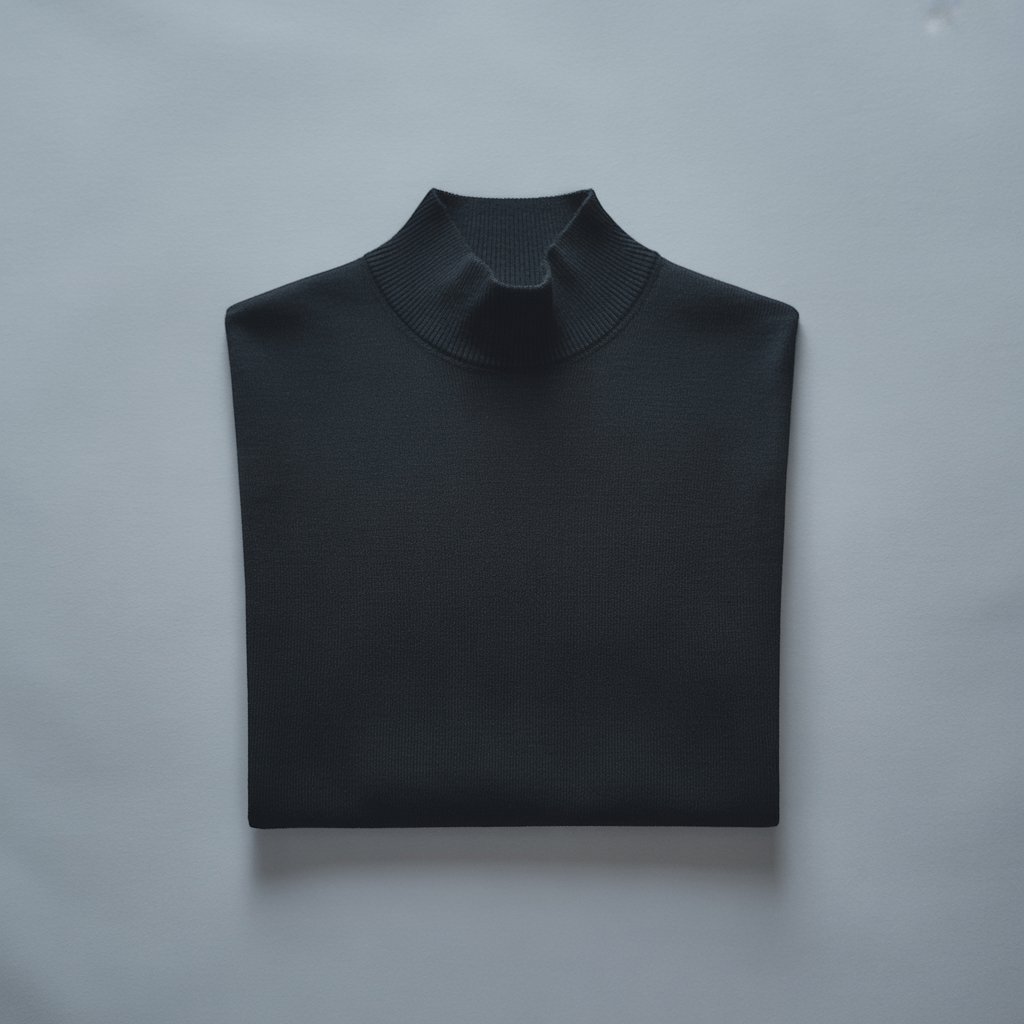
You know the version. Steve Jobs in his black turtleneck, Mark Zuckerberg in his gray t-shirt, Barack Obama in his gray or blue suits. Decision fatigue. Save the brain energy for what matters. One less thing to think about. The whole framing has hardened into a kind of self-help koan for the productivity-minded — wear the same thing, think harder.
It's a great story. It's also wrong in some specific and interesting ways, and the wrong parts are doing a lot of work shaping how people think about clothes. Tech-bro dress culture, "founder mode" minimalism, the entire genre of LinkedIn posts about adopting a personal uniform — they all trace back to Jobs. Even DRESSED exists in part because the myth is so widely believed that millions of people now feel a low-grade guilt about caring what they wear, as if it were a moral failing the great minds had transcended.
The myth deserves a careful look. Not because debunking it is fun — though it kind of is — but because the actual story is much more useful than the popular one if what you're trying to do is get dressed in the morning.
The myth, plainly stated
Here's what most people remember:
Steve Jobs wore a black mock turtleneck, Levi's 501s, and New Balance sneakers nearly every day from the late 1990s until his death. The popular reading is that he didn't want to think about clothes — but the reasoning he actually gave, according to Walter Isaacson, was different. Jobs admired the company uniforms he'd seen at Sony's Japanese factories and wanted Apple to have something similar. When Apple employees rejected the idea, he commissioned a personal version from designer Issey Miyake instead.
Mark Zuckerberg wore a gray t-shirt nearly every day. At Facebook's first public Q&A in November 2014, an audience member asked him why. His answer, widely quoted ever since: "I really want to clear my life to make it so that I have to make as few decisions as possible about anything except how to best serve this community." He went on to talk about psychology research on decision fatigue.
President Obama said something similar in Michael Lewis's October 2012 Vanity Fair profile, explaining why he only wore gray or blue suits: "I'm trying to pare down decisions. I don't want to make decisions about what I'm eating or wearing. Because I have too many other decisions to make."
The composite story most people walk away with: serious people don't waste energy on clothes. The clothes they do wear are deliberately boring. The boringness is the point.
That last sentence is the part that's wrong.
The actual story — Steve Jobs
The black turtlenecks were custom-designed for Jobs by Issey Miyake. This part is well-documented in Walter Isaacson's 2011 biography. Jobs had visited Sony's Japanese factories in the early 1980s and admired the company's uniformed workforce — Miyake had designed Sony's vest. Jobs wanted Apple to have something similar, and even floated the idea to his employees, who hated it. So he abandoned the company-wide plan and quietly commissioned Miyake to design something for himself instead.
According to Isaacson, Jobs ended up with about a hundred of those black mock turtlenecks. He told Isaacson he had enough to last for the rest of his life. The Hollywood Reporter's coverage of the biography repeats the figure, as do most major outlets that covered the book at the time of its release.
So pause on the actual mechanics here. The "I don't want to think about clothes" guy:
- Visited Japanese factories and was struck enough by the workforce uniforms to bring the idea home
- Personally cold-called one of the most famous fashion designers of the 20th century
- Had Miyake design a custom garment specifically for him
- Bought roughly a hundred of them in a single bulk order
That is, by any reasonable measure, a person who thought a lot about clothes. The boring outfit didn't fall into his lap; he engineered it. He chose Issey Miyake specifically — a designer associated with conceptual rigor, Japanese minimalism, and the idea of clothing as architecture rather than fashion. The black mock turtleneck wasn't an absence of style. It was a very particular style, signed by a very particular designer, executed at considerable expense.
The Jobs of the late 1990s knew exactly what message that outfit sent. He'd spent the first decade of his career in suits — there are auction-house photos of him in a Brioni and a striped Wilkes Bashford from the early 1980s. He moved into the turtleneck when he came back to Apple as a man who needed to project a coherent design philosophy across a company in trouble. The uniform did real work.
The actual story — Mark Zuckerberg
Zuckerberg's gray t-shirts are custom-ordered from Brunello Cucinelli, the Italian designer known as the "King of Cashmere." Cucinelli's clothing is a Silicon Valley billionaire signal — Marc Benioff, Jeff Bezos, Reid Hoffman, and Dick Costolo have all been linked to the brand, and Cucinelli is a regular guest at Salesforce's Dreamforce conference, where he and Benioff have done public conversations about what Cucinelli calls "humanistic capitalism."
The shirts cost between $300 and $400 each. W Magazine reported the figure in 2018, CNBC put it at "almost $300" in 2019, and a 26-year-old Austrian fashion entrepreneur tracked them down so meticulously to make replicas that he ended up running a charity t-shirt business off the difference between the Cucinelli original and his $47 reproduction.
We know Zuckerberg is not immune to fashion because we know the pigeon gray T-shirts he favors are custom-ordered from Brunello Cucinelli, and we know they go for upwards of $300 a pop.
— W Magazine, April 2018
So when Zuckerberg said at the 2014 town hall that he wanted to clear his life of frivolous decisions, the wardrobe he was describing was not a generic gray t-shirt. It was a custom-ordered luxury basic from a designer Zuckerberg admires for his philosophy of business — a designer whose company headquarters in the Italian village of Solomeo is essentially a planned utopian community where workers are guaranteed long lunches, restored architecture, and what Cucinelli calls a "dignity wage."
If you own a closet full of those, you have spent on the order of tens of thousands of dollars on t-shirts. You have selected, after some thought, a brand whose corporate philosophy aligns with the public image you're cultivating. You have chosen gray rather than black or white because gray reads as relaxed, approachable, and a touch California, where black would have read as Steve Jobs cosplay.
That's not a wardrobe of someone trying to stop thinking about clothes. That's a wardrobe of someone who thought about clothes very carefully, once, and then stopped.
Elizabeth Holmes is the proof
The strongest evidence that the Jobs uniform was a constructed image, rather than the absence of one, is that someone else was able to put it on like a costume.
Elizabeth Holmes founded Theranos in 2003 dressed, by the account of her chief design architect Ana Arriola, in "frumpy gray pantsuits and Christmas sweaters." This is from John Carreyrou's Bad Blood, the Wall Street Journal reporter's book on the Theranos fraud. Arriola had been hired specifically to make Theranos products feel like Apple products. She also gave Holmes a fashion suggestion. Carreyrou's account:
People in her entourage were beginning to compare her to Steve Jobs. If so, she should dress the part, [Arriola] told her. Elizabeth took the suggestion to heart. From that point on, she came to work in a black turtleneck and black slacks most days.
— John Carreyrou, Bad Blood, 2018
By 2015, Holmes had refined the persona enough to give Glamour a quote that is almost word-for-word the Jobs framing:
My mom had me in black turtlenecks when I was, like, eight. I probably have 150 of these. It's my uniform. It makes it easy, because every day you put on the same thing and don't have to think about it — one less thing in your life. All my focus is on the work.
— Elizabeth Holmes, Glamour, 2015
Holmes, according to one of her former colleagues, also kept a framed printout of Steve Jobs's Apple bio on her wall, dated August 24, 2011 — the day Jobs stepped down as CEO. She reportedly stocked up on the exact Issey Miyake turtleneck Jobs had worn when the brand reissued it in 2017. By the time her company collapsed, the persona had become Halloween-costume material.
This is the diagnostic. If a thing can be deliberately copied as an image, it was an image the first time. Holmes didn't accidentally arrive at the Jobs uniform. Her chief design architect, hired to make her company look like Apple, told her to put it on. She did. It worked. For a while.
The reason this matters for the larger argument is that it forces a choice. Either Holmes was wearing a costume and Jobs was not — in which case there's some mysterious essence that distinguishes the same clothes worn by different people, which doesn't seem right — or both of them were wearing costumes, and Jobs's costume was just better in the sense that he'd commissioned it himself and built a company that gave it meaning. The second reading is more honest. It's also the one that actually tells you something useful.
What the myth actually tells you about getting dressed
Two things are going on at once in the popular telling, and they're worth separating.
The first is the decision-fatigue logic. That part is real, it's well-supported, and it generalizes. Every choice you make uses some mental energy; reducing the number of small choices in a day frees that energy for bigger ones. There's nothing wrong with this. It's why the wardrobe paralysis problem exists in the first place — the morning is a high-decision moment and clothes are an avoidable decision tax. Anyone who's ever wasted twenty minutes staring at a closet knows the cost is not zero.
The second is the part that's wrong. The implicit claim is: therefore the uniform should be unconsidered, plain, indifferent. Therefore the goal is to wear the cheapest, simplest thing. Therefore caring about how an outfit looks is itself the problem.
That's exactly backwards. What Jobs and Zuckerberg figured out is that the way to stop deliberating about clothes every morning is to deliberate about them very intensely once. Pick a thing. Pick the right thing. Then stop. The reduction in daily friction comes from the upfront work, not from the absence of work.
This sounds obvious, but the popular version actively obscures it. People hear "Steve Jobs didn't think about clothes" and conclude that not thinking about clothes is the move. They show up to a meeting in a wrinkled hoodie because that's what the great minds were doing. What the great minds were actually doing was wearing a custom Japanese designer turtleneck whose every measurement had been considered, and reaping the benefits of having considered it.
The "I don't have to think about clothes" outcome is real and worth wanting. The path to it is not stop caring. The path is care a lot, once, and build a small system you don't have to revisit.
You don't need a literal uniform
The other thing the myth obscures is that wearing the exact same garment every day is only one possible solution. It's an extreme version of a more general idea, which is having a small set of pre-decided outfit shapes you rotate through.
If the goal is to remove the morning decision, you don't need a single black turtleneck. You need to know in advance — say — that you have five workday outfits, four casual outfits, two going-out outfits, and one occasion outfit, and that each of those exists with the right shoes already attached. That's a wardrobe formula. The morning decision becomes which of the five workday outfits the weather and your calendar suggest, not what to wear from a hundred unrelated possibilities.
This is the version that actually scales. The literal uniform works for tech CEOs because their lives are unusually narrow — they go to one office, give similar talks, present a consistent persona to a consistent audience. Most people's lives are not narrow in that way. You have a job, sure, but you also have weekends, weddings, grocery runs, dates, gym sessions, a kid's school play. A literal uniform handles approximately one of those contexts well.
A small set of outfit shapes handles all of them, and gives you the same payoff: no morning paralysis, no wasted brain energy, no twenty-minute closet stare. The decision fatigue you're trying to escape is escaped just as completely. You just don't have to look like Steve Jobs to escape it. A capsule wardrobe is the version of this that most people will actually use.
What to actually take from this
Three things, mostly:
Don't confuse "thoughtfully simple" with "didn't think about it." The cleanest, most apparently effortless wardrobes in the world are the ones that took the most thought to assemble. The Jobs turtleneck is the extreme version, but the principle scales down. A capsule wardrobe is not what you get when you give up on clothes; it's what you get when you take them seriously enough to stop tolerating items that don't earn their hanger space.
Decide once, not every day. The point of the upfront work is to eliminate the daily work. If you're still standing in front of your closet for fifteen minutes most mornings, your wardrobe hasn't been edited yet. The morning isn't where the editing happens.
The "I don't care" line is itself a style choice. Both Jobs and Zuckerberg cultivated an image of indifference to clothes that was, in practice, a very specific aesthetic — Japanese minimalism in Jobs's case, Italian luxury minimalism in Zuckerberg's. If you adopt the line without the underlying construction, you don't get the same effect. You just get the wrinkled hoodie.
What you're trying to land on is a small, pre-considered wardrobe whose pieces you've actually chosen and that fits your real life — not a hundred copies of one shirt from a Japanese designer, but the underlying principle that one thoughtful round of decisions saves you a thousand thoughtless ones. That's the lesson the myth was always pointing to. It's just easier to see once you stop believing the part where they didn't care.
DRESSED looks at your actual wardrobe, the weather, your calendar, and what you've worn recently — and gives you one answer for what to put on today. Not options. The answer. The formula-finding happens behind the scenes, and the outfit is built from clothes you already own.
Try DRESSED Free →Frequently asked questions
Why did Steve Jobs wear the same black turtleneck every day?
Jobs commissioned the turtlenecks from Issey Miyake after admiring uniformed Sony factory workers in Japan. According to Walter Isaacson's biography, he ended up with about 100 of them. The "I don't want to think about clothes" framing came later — the garment itself was a deliberate, expensive, custom-designed piece by one of the most respected fashion designers of the 20th century.
How much do Mark Zuckerberg's gray t-shirts cost?
Between $300 and $400 each, custom-ordered from Italian designer Brunello Cucinelli. W Magazine reported the figure in 2018, CNBC corroborated it in 2019, and a fashion entrepreneur tracked them down precisely enough to make $47 replicas.
What did Mark Zuckerberg actually say about wearing the same shirt?
At Facebook's first public Q&A in November 2014, Zuckerberg said he wanted to "clear my life to make it so that I have to make as few decisions as possible about anything except how to best serve this community." He cited decision fatigue research. The widely-quoted line is real — but the wardrobe he was describing was custom Cucinelli, not generic gray t-shirts.
Did Elizabeth Holmes copy Steve Jobs' look on purpose?
Yes. According to John Carreyrou's Bad Blood, Theranos's chief design architect Ana Arriola explicitly told Holmes that if people were going to compare her to Jobs, she should dress the part. Holmes adopted the black turtleneck and slacks from that point on. By 2015 she told Glamour she owned about 150. The Holmes case is the strongest evidence that the Jobs uniform was a constructed image — it could be deliberately copied as one.
Should I adopt a personal uniform like Steve Jobs?
You don't need to. The decision-fatigue benefit is real, but a literal one-outfit uniform is only one way to get it. A small set of pre-decided outfit shapes — say five workday outfits, four casual ones, a couple for going out — gives you the same morning-decision elimination without committing to wearing the same garment every day. Most people's lives have more contexts than a tech CEO's, and a literal uniform handles only one of them well.