Wardrobe paralysis is the feeling of having nothing to wear despite owning a full closet. It's caused by choice overload, poor visibility into what you own, and a wardrobe that's grown by impulse rather than design. The fix is reducing options, not adding more clothes.
You own 80 pieces of clothing. You wear the same 15. Every morning you stand in front of a full closet feeling stuck. Here's why — and how to fix it.
What is wardrobe paralysis?
Wardrobe paralysis is the feeling of having nothing to wear despite owning a closet full of clothes. It's not about the quantity of clothes you own. Barry Schwartz wrote a whole book about this — the Paradox of Choice — which basically says that beyond a certain point, more options make decisions harder, not easier. In wardrobe terms: owning 100 items doesn't give you 100 more choices. It just makes the decision worse before you've had your first cup of coffee.
The outfit decision is competing with your actual best thinking of the day. It's not a fashion problem. It's a decision problem.
I ran into this hard enough that I built an app to fix it. I was using Google Gemini to help me pick outfits — just describing what I owned and asking for suggestions. It worked until the next conversation, when it had forgotten everything. I asked it how to fix that and it said: connect the AI to a database. Two weeks later I had DRESSED. The wardrobe paralysis problem turned out to be a data visibility problem with a technical solution, which is a sentence I would not have predicted writing at 51.
A smaller, well-curated closet makes you happier than a larger, overwhelming one. Schwartz proved this with data. Your closet is proving it every morning.
The numbers behind the problem
A large-scale study by WRAP found UK adults own an average of 118 clothing items but leave a quarter of them unworn for at least a year. A study of 18,000 households across 20 countries found Americans leave 82% of their wardrobe unworn in a given year. That 82% is sitting there making every morning harder.
Most of the writing on wardrobe paralysis, including the stats above, leans on a handful of older studies and a lot of stylist convention — because the data isn't out there. We're trying to fix that. If you have two minutes, we'd love your honest answers on how you actually get dressed: how long it takes, how often it frustrates you, whether you have a system. Take the 2-minute survey. We'll publish the results.
Five reasons it happens
How to fix it
There are two approaches: do it manually, or let an app do the daily decision for you. Most people benefit from starting manually and then using technology to maintain it.
The AI solution
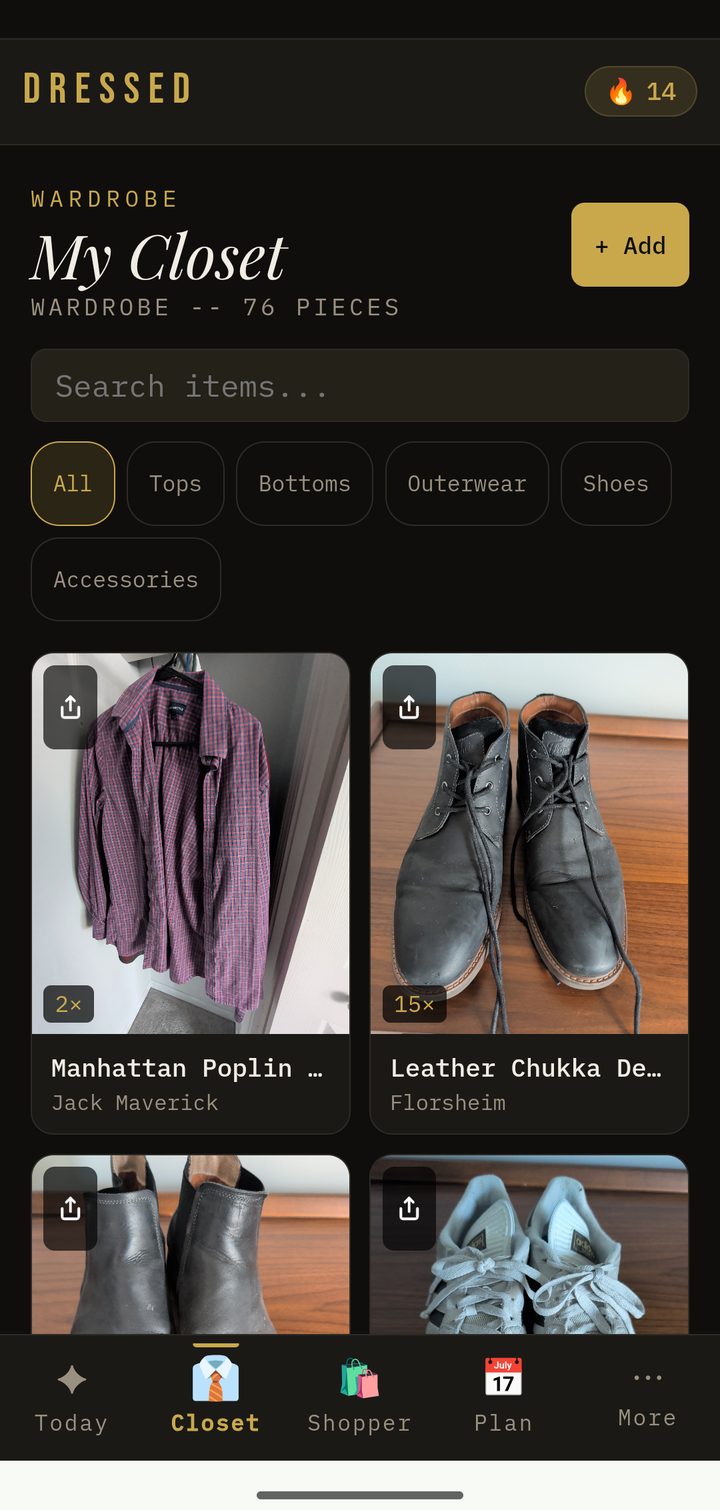
The manual approach works but requires ongoing discipline. The more sustainable fix is to remove the daily decision entirely. Some people solve this by removing the choice entirely — the Steve Jobs turtleneck is the best-known version.
That's what DRESSED is built to do. You scan your wardrobe once — the AI identifies each piece from a phone photo — and every morning it builds an outfit from your actual clothes based on your weather and your calendar. You tell it what you're wearing or not, and it learns from that over time. After a few weeks, the morning routine changes. Instead of standing in front of the closet wondering what to wear, you open the app and see your outfit.
What is wardrobe paralysis?
Wardrobe paralysis is the feeling of having nothing to wear despite owning a full closet. It's a form of choice overload — too many options make the decision harder, not easier. Research consistently shows most people wear only 20-30% of what they own, which means the other 70-80% is creating visual noise without adding value.
Why do I keep wearing the same clothes?
Because your brain has already done the work of figuring out which combinations work. Defaulting to those is a rational shortcut, not a character flaw. The fix is making more of your wardrobe feel equally safe to reach for — either through better organization or by using an app that builds the combinations for you.
Is wardrobe paralysis related to anxiety?
Yes. The fear of making the "wrong" choice — being underdressed for something, not looking put-together — elevates the decision beyond its actual stakes. Morning time pressure makes this worse. Decision fatigue research shows we make worse choices as the day goes on, which is why many people find morning outfit decisions particularly difficult.
How many clothes does the average person own?
Studies consistently find the average American owns 80-120 items. Of those, most people regularly wear only 20-30% — meaning 50-80 items are sitting unused. A large-scale WRAP study of UK adults found 118 items owned on average, with a quarter unworn for at least a year.
Does a capsule wardrobe fix wardrobe paralysis?
A capsule wardrobe reduces choices to a number where all combinations work, which is one effective solution. It requires significant upfront effort. For people who want to keep a larger wardrobe, a good system — like an AI stylist — can achieve the same low-friction morning routine without giving up the clothes you have.