Cost per wear calculator
Enter what you paid and how many times you've worn it. The formula is simple: cost ÷ wears = cost per wear.
What does a good cost per wear actually look like?
These benchmarks are guidelines, not rules. Context matters — a $200 wedding suit worn once is different from a $200 work shirt worn once.
Exceptional
Your everyday workhorses. A pair of jeans worn three times a week, your go-to work shirt, a coat you wear for five months every year. These are your best investments.
Excellent
Items you reach for regularly but not every day. A good blazer, a versatile pair of boots, a sweater that works for multiple occasions. Strong value for most wardrobes.
Reasonable
Seasonal items or pieces for specific occasions. A linen shirt for summer, a dress you wear to events, formal shoes. Acceptable if the item genuinely serves its purpose.
Worth reviewing
Items in this range should prompt a question: why hasn't it been worn more? Is it a fit issue, a style mismatch, or does it not go with anything else you own?
Underperforming
High CPW items are often candidates for donation or consignment — unless they're genuine special occasion pieces you'll wear again. Don't confuse "expensive" with "valuable."
Cost per wear in practice
The numbers often challenge intuition. Expensive items worn constantly beat cheap items worn rarely — every time.
| Item | Price | Wears | CPW | Verdict |
|---|---|---|---|---|
| $300 wool overcoat — worn daily Oct–Mar | $300 | 150 | $2.00 | GREAT |
| $180 dark denim jeans — weekly rotation | $180 | 120 | $1.50 | GREAT |
| $90 Oxford shirt — worn 2-3x per week | $90 | 80 | $1.13 | GREAT |
| $60 summer dress — worn a few times | $60 | 6 | $10.00 | REVIEW |
| $45 trendy top — worn twice last season | $45 | 2 | $22.50 | POOR |
| $25 fast fashion shirt — never worn | $25 | 0 | ∞ | POOR |
What cost-per-wear tracking looks like in DRESSED
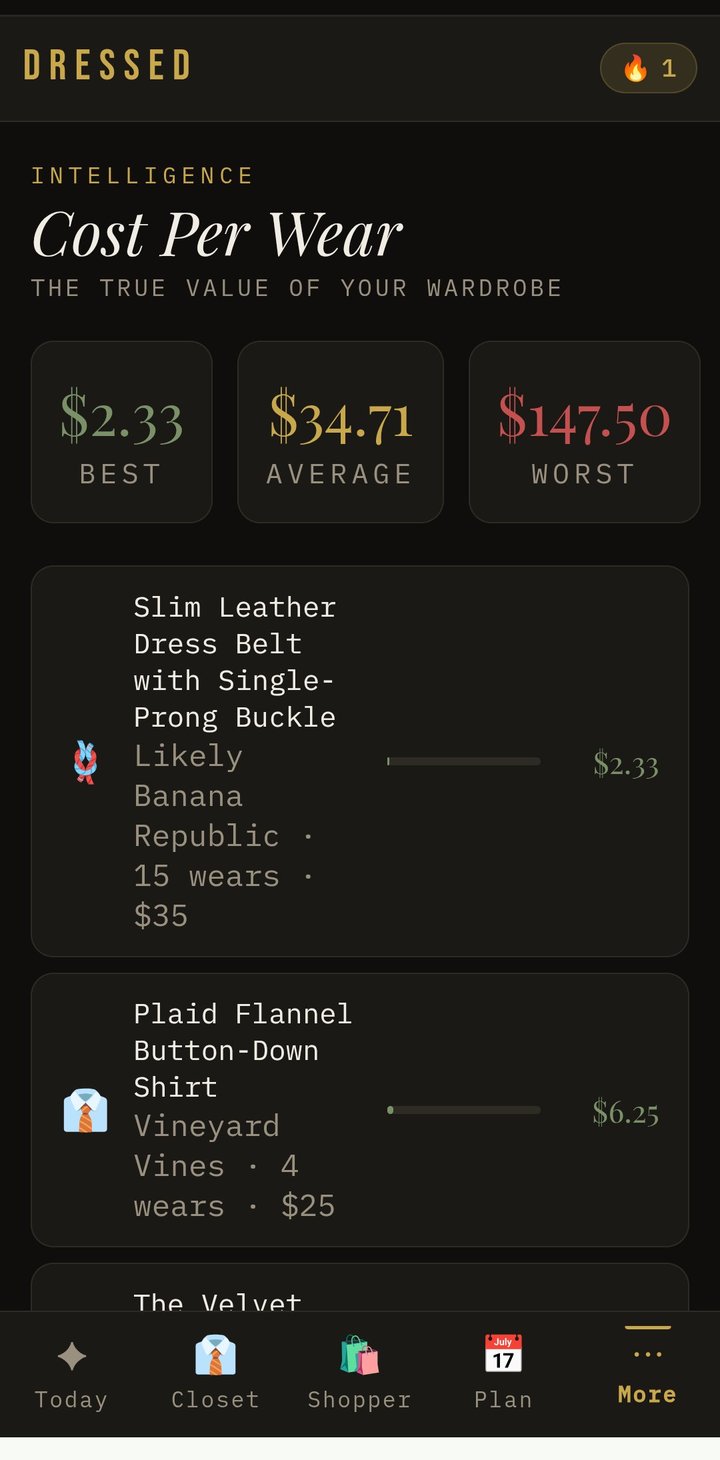
Every item in your digital wardrobe accumulates a wear count automatically. The Cost Per Wear view ranks everything from best to worst — no manual logging required.
What cost per wear tells you about your wardrobe
Most people have a mental model of their wardrobe that's wrong in a specific direction: they overestimate how often they wear things they like the idea of, and underestimate how often they reach for the same core items.
Tracking cost per wear for a few weeks tends to surface the same pattern across most wardrobes:
20% of your wardrobe accounts for 80% of your wears. The rest — the aspirational purchases, the impulse buys, the things that seemed like a good idea — is costing you money and creating the visual clutter that leads to feeling like you have nothing to wear.
The practical implication isn't "buy nothing." It's "buy things you'll actually wear." CPW analysis points to what that looks like for your specific wardrobe: the colors, categories, and occasions you consistently dress for. That's the wardrobe worth investing in. A capsule wardrobe built around your highest-CPW categories is exactly where to start.
DRESSED tracks this automatically. Every item in your digital wardrobe accumulates a wear count, and the Cost Per Wear view shows your full ranking — best to worst — without any manual logging required.
Common questions about cost per wear
What is cost per wear?
Cost per wear is the price of a clothing item divided by the number of times you've worn it. A $200 jacket worn 100 times has a cost per wear of $2.00. A $30 shirt worn twice has a cost per wear of $15.00. The metric reveals which clothes are actually worth their price and which are wasting space in your wardrobe.
How do you calculate cost per wear?
Cost per wear = item price ÷ number of wears. For example: a $150 pair of jeans worn 80 times = $1.88 per wear. A good benchmark is anything under $5 per wear is excellent value; $5–15 is reasonable; over $15 means the item isn't earning its place in your wardrobe.
What is a good cost per wear?
Under $1 per wear is exceptional — typically everyday basics like your go-to jeans or a work shirt you wear weekly. Under $5 is excellent. $5–15 is reasonable for items worn occasionally. Above $15 per wear suggests an item isn't getting enough use to justify its cost, though special occasion pieces (wedding attire, formal wear) are exceptions.
Does DRESSED track cost per wear automatically?
Yes. DRESSED tracks how often you wear each item in your digital wardrobe and automatically calculates cost per wear for everything you own. The Cost Per Wear view shows your best-value items and your worst — the clothes quietly costing you the most per use.
Should I donate clothes with a high cost per wear?
High cost per wear is a useful signal, not an automatic verdict. Ask why the item has a high CPW: is it a special occasion piece you'll wear again? Or is it something you avoid wearing because it doesn't fit or doesn't go with anything? Items in the second category are worth reconsidering. Items that genuinely get worn for specific occasions are worth keeping even at high CPW.
Is a $500 coat worth it if I wear it every day?
Almost certainly yes. A $500 coat worn 150 days a year for 3 years comes to $1.11 per wear — cheaper per use than most fast fashion items. Cost per wear rewards exactly this kind of thinking: investing more in items you'll wear constantly, and being more careful about items you might wear once or twice.
Track cost per wear automatically.
DRESSED logs every wear and calculates cost per wear for your entire wardrobe — no spreadsheet needed. Free to try.
Start Tracking Free →